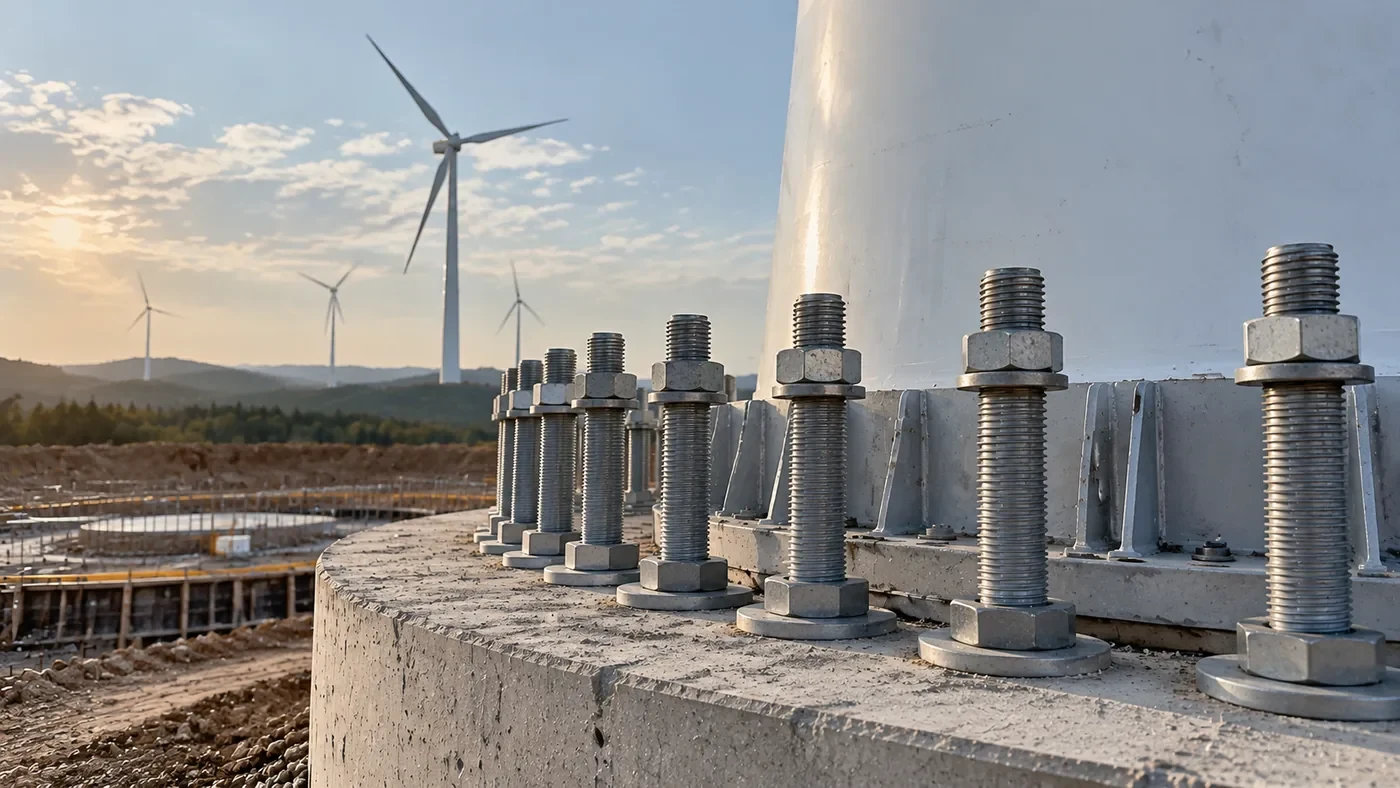
Wind turbine foundation anchor bolts are critical components in the connection between a turbine tower and its concrete foundation. Although they may look like simple steel fasteners, their dimensions, material properties, anchoring configuration, and installation requirements all affect the performance of the foundation connection.
For buyers, sourcing these components involves more than finding a manufacturer that can produce the required size. The key is to ensure that the anchor bolts meet the approved engineering drawings, applicable standards, and project-specific quality requirements.
This guide covers the main technical considerations buyers should review before placing an order for wind turbine foundation anchor bolts.
1. Understanding the Requirements for Wind Turbine Foundation Anchor Bolts
Foundation anchor bolts transfer loads through the anchoring system connecting the tower base to the concrete foundation. Depending on the turbine design, this connection must accommodate tensile forces, bending-related effects, and repeated loading during operation.
The required anchor bolt configuration depends on the turbine model, foundation design, structural calculations, and installation method. Different projects may use different bolt arrangements, anchoring components, and dimensional requirements.
For this reason, anchor bolts should not be selected by diameter alone. Components that appear similar may differ in their mechanical properties, effective anchorage, thread configuration, or overall geometry.
Before sourcing anchor bolts, buyers should obtain the approved drawings and technical specifications. These documents provide the basis for confirming the required product configuration and determining whether a supplier can manufacture the components as specified.
2. Dimensions, Thread Specifications, and Component Compatibility
Dimensional accuracy is essential when manufacturing foundation anchor bolts. The specification should clearly define the nominal diameter, overall length, thread pitch, thread length, and the position of any anchoring features.
It is particularly important to distinguish overall length from embedded length and exposed length. These dimensions describe different parts of the anchoring arrangement and must follow the measurement references shown on the approved drawings.
The specified configuration may include straight anchor bolts, threaded sections, anchor plates, anchor heads, sleeves, or other components. Their dimensions and positions should not be changed without approval from the responsible engineering party.
Thread compatibility also requires careful attention. The bolt, nut, and washer specifications should be considered as a complete assembly. Buyers should confirm the applicable thread standard, tolerance requirements, mating nut specifications, and washer dimensions.
If surface treatment is required, thread compatibility must be checked again in relation to the finished product. Clear dimensional and assembly requirements help reduce the risk of installation difficulties and costly adjustments on site.
3. Material Grades and Applicable Standards
Material selection is another important part of the purchasing process. Descriptions such as high-strength steel are not sufficient to define the material requirements for a wind turbine foundation anchor bolt.
The purchase specification should identify the applicable product or material standard, the required grade or property class, and any additional mechanical performance requirements.
For example, ASTM F1554 includes several grades of anchor bolts, while metric fasteners may use property-class designations under applicable ISO standards. These systems have different requirements and should not be treated as directly interchangeable.
The correct specification depends on the intended application and the approved project design. Buyers should confirm that the selected material and product standard are suitable for the particular anchoring system rather than choosing a grade based only on its strength designation.
Material certificates and mechanical test reports may also be required. The specific tests and documents should be established in advance, including any requirements for batch identification, traceability, or third-party inspection.
4. Corrosion Protection and Surface Treatment
Foundation anchor bolts may require corrosion protection according to the project environment, design life, and engineering specification. Hot-dip galvanizing and other approved protection systems may be used where appropriate.
However, specifying a coating type alone does not define the complete requirement. Buyers should confirm the applicable coating standard, inspection criteria, and any requirements concerning coating thickness, appearance, and finished dimensions.
Threaded components require particular attention because surface treatment can affect the fit between bolts and mating nuts. The manufacturing and finishing processes should therefore be coordinated to ensure that the completed components meet the specified assembly requirements.
Packaging and transportation should also be considered. Long anchor bolts and exposed threads need appropriate protection to reduce the risk of corrosion, deformation, and mechanical damage before installation.
5. Quality Control and Inspection Requirements
Quality control should be based on the approved drawings, applicable standards, and purchase specification. General claims about product quality are less useful to buyers than clearly defined inspection procedures and documented acceptance criteria.
Depending on the project requirements, inspection may cover dimensional accuracy, thread quality, material verification, mechanical properties, surface treatment, and the compatibility of supplied nuts and washers.
Material certificates and inspection reports should be consistent with the agreed documentation requirements. Where traceability is required, the supplier should clarify how the relevant materials, production batches, and inspection records will be identified.
Buyers should also confirm whether additional testing or third-party inspection is required before shipment. These arrangements are best established before production begins, rather than after the components have been manufactured.
Clear quality requirements help both the buyer and supplier establish a consistent basis for product acceptance and reduce the likelihood of disputes during delivery.
6. Common Purchasing Issues to Avoid
Several problems can be avoided by preparing a complete technical specification before requesting quotations.
One common issue is providing only the nominal diameter and overall length. Without details concerning material grade, thread requirements, anchoring configuration, surface treatment, and inspection, the supplier may not have enough information to quote the correct product.
Another issue is confusing overall length with embedded or exposed length. Ambiguous measurement references can result in dimensional discrepancies between the quotation, manufacturing drawing, and installation requirements.
Buyers should also avoid assuming that different material standards or strength classifications are interchangeable. Any proposed substitution should be reviewed and approved by the responsible engineering party.
Finally, quality documentation, packaging, and delivery requirements should be agreed upon before production. Resolving these details early helps prevent unnecessary delays, rework, and additional costs.
7. Preparing an RFQ for Wind Turbine Foundation Anchor Bolts
A complete request for quotation helps suppliers understand the project requirements and provide a more accurate response.
Where available, buyers should provide the approved technical drawing, material and mechanical requirements, thread specifications, surface treatment requirements, order quantity, and expected delivery schedule.
The RFQ should also identify any required material certificates, inspection reports, traceability arrangements, packaging instructions, and third-party verification.
If some technical details remain undecided, they should be clearly identified for confirmation rather than left open to assumption. The supplier can then review the available information, identify missing requirements, and discuss manufacturing feasibility before the order is released.
For custom foundation anchor bolts, a clear specification is often the most effective starting point for reducing misunderstandings and keeping the procurement process on track.
Sourcing Wind Turbine Foundation Anchor Bolts from MetalVanta
MetalVanta supplies industrial fastening products, including foundation anchor bolts and other custom fasteners for industrial applications.
For buyers sourcing wind turbine foundation anchor bolts, we can work with drawings and project specifications to discuss product requirements and coordinate manufacturing with the supply chain.
Whether your project requires specific dimensions, custom configurations, matching hardware, or defined inspection documentation, providing the technical requirements at the beginning helps establish a clearer basis for quotation and production planning.
Contact MetalVanta to discuss your foundation anchor bolt requirements or submit your drawings and RFQ for an initial review.
Discuss Your Requirement.
Tell us what your connection needs, with or without a drawing.
Start An Enquiry